Uses, Features and Drawbacks of Pointers in C Language
Many students struggle with pointers at first.
But once you understand how they work, C programming becomes much more powerful and flexible.
In this tutorial, we are going to understand one of the most important concepts in C programming — pointers.
In this section, we will focus specifically on the uses and features of pointers, along with their drawbacks.
In the previous tutorial, we learned what a pointer is. Let us quickly review the basic syntax of a pointer.
Syntax:
datatype *variable_name;
Here, *variable_name represents a pointer variable, and the datatype must be a valid C data type such as int, float, char, etc.
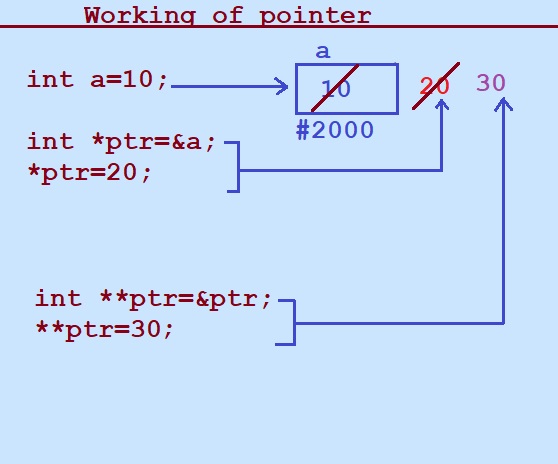
In the given figure:
int a = 10;
An integer variable a is declared and initialized with the value 10.
int *ptr = &a;
The pointer ptr stores the address of variable a.
*ptr = 20;
When we assign 20 to *ptr, we are actually modifying the value stored at the address of a.
As a result, the value of a becomes 20. This happens because the pointer holds the address of a, so any change made using the pointer directly affects the original variable.
Now, let us understand the main uses and features of pointers in C language.
Uses of Pointer in C
1. Passing Arguments by Reference: Pointers allow functions to modify the original variables instead of working on copies.
2. Returning Multiple Values from a Function: Using pointers, a function can update multiple variables and effectively return more than one value.
3. Accessing Array Elements: Pointers can be used to efficiently access and manipulate elements of an array.
4. Dynamic Memory Allocation: Pointers are used with functions like malloc(), calloc(), and free() to allocate and manage memory dynamically at runtime.
5. Implementing Complex Data Structures: Data structures such as linked lists, stacks, queues, trees, and graphs rely heavily on pointers.
6. System-Level Programming: Pointers are useful in system programming where direct memory access is required.
Features of Pointers in C
1. Efficient Memory Management: Pointers allow dynamic allocation and deallocation of memory, improving memory usage.
2. Reduced Memory Usage: Instead of copying large data, pointers pass memory addresses, saving space.
3. Faster Program Execution: Since pointers provide direct access to memory locations, data manipulation becomes faster.
4. File Handling Support: Pointers are commonly used in file operations such as reading, writing, and modifying files.
5. Support for Data Structures: Pointers are essential for implementing advanced data structures and multidimensional arrays.
6. Flexible Array Access: Arrays of any type can be accessed using pointer arithmetic without relying only on index notation.
7. Dynamic Allocation Capability: Pointers make runtime memory allocation possible.
Drawbacks of Pointers in C
• If a pointer refers to an incorrect or invalid memory address, it may read or modify unintended data.
• Uninitialized pointers can cause unpredictable behavior and may lead to segmentation faults.
• Pointer errors are often difficult to debug and trace.
• Each pointer access requires an additional dereferencing step.
• Forgetting to free dynamically allocated memory can result in memory leaks.